International Commercial Terms (Incoterms 2020) are among the most important rules used in import, export, and international shipping operations. They help determine the responsibilities of both the seller and the buyer, from the signing of the sales contract through to the delivery of the goods at the agreed destination.
These rules are used worldwide to standardize the interpretation of trade terms, reducing commercial disputes and making transportation operations clearer and more organized. The International Chamber of Commerce (ICC) issued the first version of these rules in 1936, and they are periodically updated to keep pace with developments in global trade. Incoterms 2020 is currently the applicable edition.
In the United Arab Emirates, Incoterms are widely used in import and export operations through ports and airports such as Jebel Ali Port, Khalifa Port, and Dubai International Airport. They help companies determine their responsibilities in international shipping operations and reduce commercial disputes.
Why Do We Use Incoterms?
An international shipment passes through several stages before reaching the buyer, including inland transportation, international shipping, customs clearance, unloading, and final delivery. During these stages, additional costs may arise, or goods may be damaged or delayed.
Therefore, Incoterms help clearly determine each party’s responsibilities before the shipping process begins.
Their main benefits include:
- Defining the responsibilities of the seller and buyer.
- Clarifying the point at which risk transfers.
- Allocating transportation and shipping costs.
- Determining responsibility for insurance.
- Organizing export and import procedures.
- Reducing commercial disputes.
- Standardizing international trade terminology.
What Do Incoterms Rules Determine?
Incoterms rules are based on several key elements that should be agreed upon by both parties before carrying out the shipping operation.
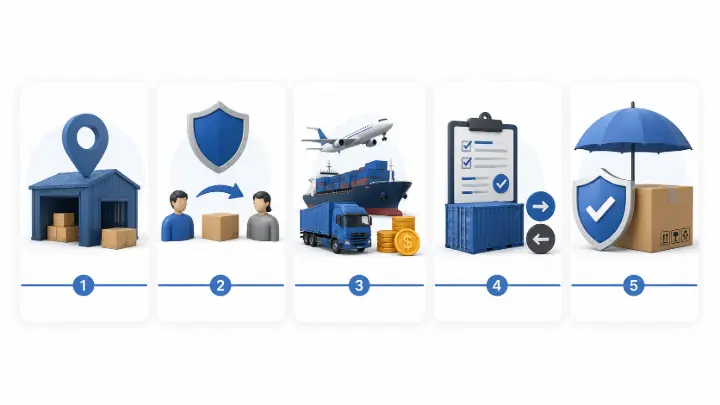
1. Place of Delivery
Each Incoterm has a specific delivery point, which is the point at which the seller is considered to have fulfilled their obligations.
The delivery location may be:
- The seller’s factory.
- The seller’s warehouse.
- A freight terminal.
- The port of loading.
- The port of arrival.
- The buyer’s warehouse.
- Any location agreed upon by both parties.
Precisely specifying the place of delivery is one of the most important provisions in the sales contract because it determines the beginning of the buyer’s responsibility and the end of the seller’s responsibility.
2. Transfer of Risk
One of the concepts that is frequently misunderstood is the transfer of risk.
The transfer of risk does not necessarily mean the transfer of transportation costs. The seller may pay shipping costs up to the port of destination, while the risk associated with the goods may have already transferred to the buyer when the goods were loaded onto the vessel.
Therefore, it is always important to distinguish between:
- Transfer of risk.
- Responsibility for transportation costs.
3. Transportation Costs
Incoterms specify which party is responsible for paying transportation costs at each stage.
These may include:
- Inland transportation.
- Ocean freight charges.
- Air freight charges.
- Road transportation costs.
- Handling charges.
- Port charges.
- Unloading costs.
The allocation of these costs varies depending on the agreed trade term.
4. Export and Import Procedures
Incoterms determine which party is responsible for completing customs procedures.
These may include:
- Obtaining export documents.
- Customs clearance in the country of origin.
- Import documentation.
- Customs clearance in the destination country.
- Paying customs duties when applicable.
5. Cargo Insurance
Not all Incoterms require the seller to purchase insurance.
Under some terms, insurance is the buyer’s responsibility, while certain terms, such as CIF and CIP, require the seller to provide insurance coverage in accordance with the requirements specified under Incoterms 2020.
Therefore, it is always recommended to review the required insurance coverage before signing the contract, particularly when shipping high-value or perishable goods.
Classification of Incoterms
Classification of Incoterms by Mode of Transport
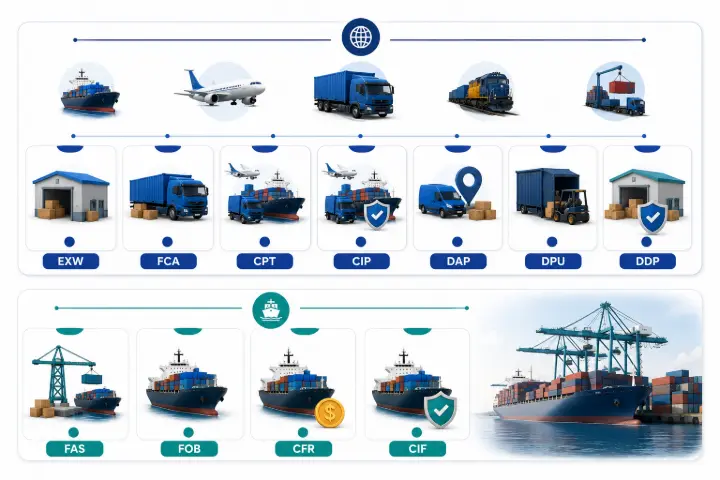
International Commercial Terms are divided into two main groups.
First: Terms Used with All Modes of Transport
They can be used for:
- Sea freight.
- Air freight.
- Road transportation.
- Rail transportation.
- Multimodal transportation.
These may include:
- EXW
- FCA
- CPT
- CIP
- DAP
- DPU
- DDP
Second: Terms Specifically Used for Sea Transport
These terms are used only when the delivery or transportation takes place by sea or inland waterway.
These may include:
- FAS
- FOB
- CFR
- CIF
These terms are recommended for general cargo or bulk goods, while terms such as FCA are generally preferred for containerized shipments.
Classification of Incoterms by the Seller’s Level of Responsibility
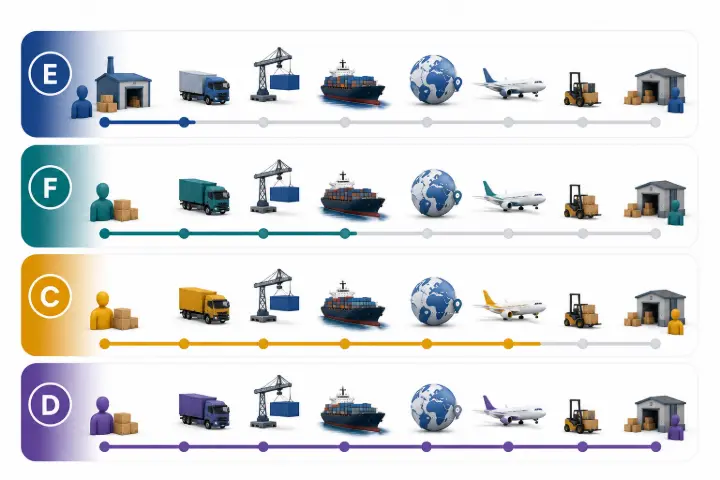
Classification of Incoterms by the Seller’s Level of Responsibility
Group E
This group contains only one term:
EXW
Under this term, the seller has the lowest level of responsibility. The seller simply makes the goods available at their premises, while the buyer assumes responsibility for all stages of transportation, export, and import.
Group F
Under this group, the seller delivers the goods to the carrier or at the port of loading, while the buyer bears the costs of the main transportation.
These may include:
- FCA
- FAS
- FOB
Group C
The seller pays the costs of the main transportation, but the risk transfers to the buyer at a specific point depending on the applicable term.
These may include:
- CFR
- CIF
- CPT
- CIP
Group D
These terms represent the highest levels of seller responsibility, as the seller’s responsibilities continue until the goods reach the agreed destination.
These may include:
- DAP
- DPU
- DDP
Explanation of Incoterms 2020
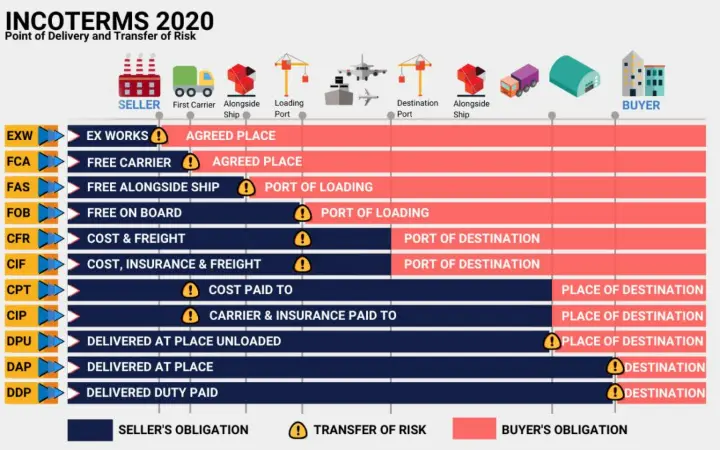
1- EXW (Ex Works)
Means delivery at the seller’s premises.
This is the term involving the lowest level of responsibility for the seller. The seller is only required to prepare the goods and make them available at the factory, warehouse, or another agreed location.
The buyer is then responsible for:
- Loading the goods.
- Inland transportation.
- Export customs clearance.
- International shipping.
- Insurance.
- Import customs clearance.
- All costs until the goods arrive.
EXW is often used when the buyer has extensive experience in managing international shipping operations.
2- FCA (Free Carrier)
Means delivery to the carrier.
The seller delivers the goods to the transportation company designated by the buyer after completing the export procedures.
The seller is responsible for:
- Preparing the goods.
- Export customs clearance.
- Delivering the shipment to the carrier.
The buyer is responsible for:
- Freight charges.
- Insurance.
- Import procedures.
- All costs after the delivery point.
FCA is one of the most commonly used terms for containerized shipments.
3- FAS (Free Alongside Ship)
Means delivery alongside the vessel.
It is used for sea transport only.
The seller delivers the goods to the port and places them alongside the vessel selected by the buyer.
From this point, the buyer is responsible for:
- Loading the goods onto the vessel.
- Freight charges.
- Insurance.
- Import procedures.
4- FOB (Free On Board)
Means delivery on board the vessel.
The seller is responsible for transporting the goods to the port of shipment and loading them onto the vessel.
Once the loading operation is completed, the risk transfers to the buyer.
FOB is one of the most widely used international trade terms for sea freight.
5- CFR (Cost and Freight)
Means Cost and Freight.
The seller is responsible for:
- Transportation costs for the goods.
- Ocean freight charges up to the port of destination.
However, the risk transfers to the buyer once the goods are loaded onto the vessel. Therefore, the seller’s payment of freight costs does not mean that the seller bears the risk throughout the entire journey.
6- CIF (Cost, Insurance and Freight)
Means Cost, Insurance and Freight.
It is similar to CFR, except that the seller is also required to purchase basic insurance coverage for the goods up to the port of destination.
This term is widely used in maritime trade when the buyer wants the seller to arrange transportation and insurance.
7- CPT (Carriage Paid To)
Means Carriage Paid To.
It can be used with all modes of transport.
The seller pays the transportation costs up to the agreed destination, while the risk transfers to the buyer when the goods are delivered to the first carrier.
8. CIP (Carriage and Insurance Paid To)
Means Carriage and Insurance Paid To.
It is similar to CPT, except that the seller is also required to purchase insurance for the goods in accordance with the requirements of Incoterms 2020.
It is commonly used for high-value goods or shipments requiring appropriate insurance coverage.
9- DAP (Delivered at Place)
Means Delivered at Place.
The seller is responsible for transporting the goods to the agreed location in the buyer’s country.
The buyer is responsible for:
- Unloading the goods.
- Import customs clearance.
- Local charges.
10- DPU (Delivered at Place Unloaded)
Means Delivered at Place Unloaded.
It is distinguished by being the only term under which the seller is responsible for unloading the goods at the destination before responsibility transfers to the buyer.
11. DDP (Delivered Duty Paid)
Means Delivered Duty Paid.
It represents the highest level of seller responsibility. The seller bears all transportation costs, shipping procedures, customs clearance, and agreed duties until the goods are delivered to the specified location.
Common Mistakes When Using Incoterms
Despite the clarity of Incoterms rules, some companies make mistakes that can lead to increased costs or disputes between the parties to the contract. The most common include:
- Failing to specify the delivery location precisely.
- Assuming that the party paying the freight charges is also the party bearing the risk.
- Using sea transport terms for unsuitable shipments.
- Failing to review insurance responsibilities before signing the contract.
- Choosing a trade term that does not match the experience of the seller or buyer.
- Failing to review the customs regulations of the importing country.
Quick Comparison Table of Incoterms 2020
| Term | Mode of Transport | Seller’s Responsibility |
|---|---|---|
| EXW | All modes | Goods preparation only |
| FCA | All modes | Delivery to the carrier |
| FAS | Sea | Delivery alongside the vessel |
| FOB | Sea | Loading onto the vessel |
| CFR | Sea | Payment of freight |
| CIF | Sea | Payment of freight and insurance |
| CPT | All modes | Payment of transportation |
| CIP | All modes | Payment of transportation and insurance |
| DAP | All modes | Delivery at the agreed place |
| DPU | All modes | Delivery after unloading |
| DDP | All modes | Delivery with duties paid |
Conclusion
Incoterms 2020 provide a foundation for organizing international trade operations by clearly defining the responsibilities of sellers and buyers regarding transportation, insurance, customs clearance, and the transfer of risk. Understanding these rules helps reduce disputes, improve shipment management, and select the most appropriate trade term for each transaction.
For companies operating in the United Arab Emirates, using the appropriate Incoterm helps facilitate import and export operations through UAE ports and airports and provides all parties with greater clarity regarding the allocation of responsibilities and costs. This, in turn, supports supply chain efficiency and contributes to the success of international trade operations.