The logistics sector has witnessed significant evolution over the past decades. Transporting goods from one point to another is no longer the sole responsibility of logistics companies. Supply Chain Management (CSCMP) now demands more integrated solutions, including warehousing, inventory management, customs clearance, transport coordination, data analytics, and the utilization of digital technologies.
With this evolution, terms such as 1PL, 2PL, 3PL, 4PL, and 5PL have emerged. These classifications are used to describe the level of logistics services a company relies on and the extent of its dependence on third-party providers to manage its operations.
Understanding these classifications helps businesses select the right model for their operations—whether they are a startup managing everything in-house or a global corporation requiring a complex, managed logistics network.
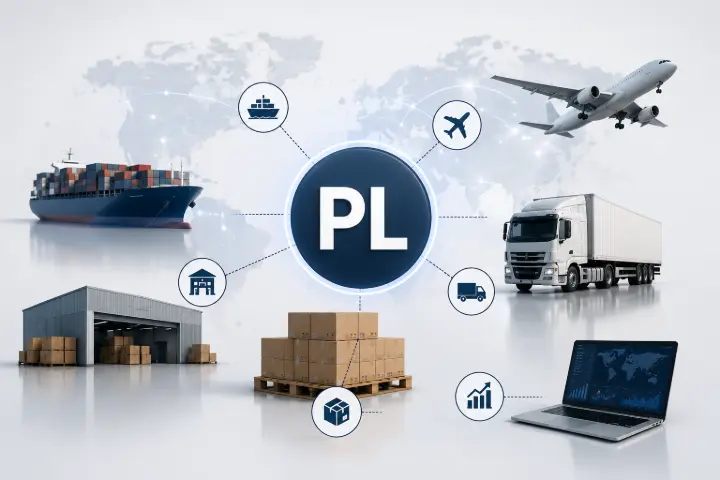
What Does "PL" Stand For in Logistics?
The acronym PL stands for Party Logistics. It indicates the degree to which a company outsources its logistics operations to third-party entities.
Generally, the higher the number preceding PL, the greater the reliance on an external service provider to manage logistics and supply chain operations.
1. What is 1PL (First-Party Logistics)?
1PL (First-Party Logistics) refers to a model where a company handles all of its logistics operations internally without relying on external service providers. Under this model, the company owns its transportation fleet, manages its own warehouses, and directly oversees distribution end-to-end.
Example:
A farm that owns its trucks and delivers its produce directly to retail stores without contracting any transport company.
Advantages:
- Complete operational control.
- Faster decision-making.
- Zero dependency on external parties.
Challenges:
- High capital/investment costs.
- Need for specialized internal staff.
- Difficulty scaling into distant or foreign markets.
2. What is 2PL (Second-Party Logistics)?
2PL (Second-Party Logistics) involves a company contracting an external provider for a specific logistics service, such as transportation or warehousing, while retaining overall management of logistics operations in-house.
Typically, the 2PL provider owns the physical assets (trucks, ships, or warehouses) used to deliver the service.
Example:
Example: A manufacturing company that manages its own supply chain but hires a road freight company to transport goods to customers.
Advantages:
- Reduced fleet ownership costs.
- Access to specialized transport expertise.
- Greater operational flexibility compared to self-management.
Challenges:
- Services are limited to specific tasks.
- Coordination responsibilities remain on the hiring company.
3. What is 3PL (Third-Party Logistics)?
3PL (Third-Party Logistics) is the most widely adopted model in the logistics industry. Here, a specialized logistics provider handles a major portion—or the entirety—of operational logistics on behalf of the client.
Services offered by a 3PL may include:
- Transportation
- Warehousing
- Inventory management
- Order fulfillment
- Packaging & labeling
- Distribution
- Reverse logistics (returns management)
This model allows businesses to focus on their core competencies while the 3PL provider manages daily execution efficiently.
Example:
An e-commerce store that partners with a logistics company to store products, fulfill orders, and ship items to end customer
Advantages:
- Lower operational costs.
- Leverage of external logistics expertise.
- Effortless market expansion.
Challenges:
- educed direct control over daily tasks.
- Crucial reliance on selecting a reliable partner.
4. What is 4PL (Fourth-Party Logistics)?
4PL (Fourth-Party Logistics) refers to an integrator that manages the entire supply chain rather than simply executing physical logistics tasks.
Instead of operating their own trucks or warehouses, a 4PL acts as a central coordinator between the client and multiple 3PL service providers, focusing on strategic planning, process optimization, and overall efficiency.
In many setups, the 4PL oversees various 3PL companies to ensure seamless integration and optimal performance.
Example:
A global enterprise operating in dozens of countries that hires a single entity to orchestrate all transport, storage, and distribution across multiple service providers.
Advantages:
- End-to-end supply chain management.
- Continuous performance optimization and cost reduction.
- High-level visibility across all operations.
Challenges:
- High dependency on a single strategic partner.
- Better suited for complex, large-scale operations than small businesses.
5. What is 5PL (Fifth-Party Logistics)?
5PL (Fifth-Party Logistics) represents the most advanced tier. It focuses on managing fully integrated, multi-supply chain networks using digital technologies, big data analytics, automation, and artificial intelligence (AI).
Rather than managing a single supply chain, a 5PL orchestrates multiple supply chains simultaneously, using digital ecosystems to drive data-informed efficiency across complex international networks.
Example:
A global e-commerce platform managing thousands of daily shipments across multiple countries using advanced digital architecture that connects suppliers, warehouses, carriers, and end customers in real time.
Advantages:
- Maximum level of digital integration.
- Data-driven decision-making and predictive analytics.
- Enhanced operational efficiency.
- High scalability for complex global operations.
Challenges:
- Requires advanced technological infrastructure.
- Tailored primarily for large enterprises with expansive networks.
Comparison: 1PL vs. 2PL vs. 3PL vs. 4PL vs. 5PL
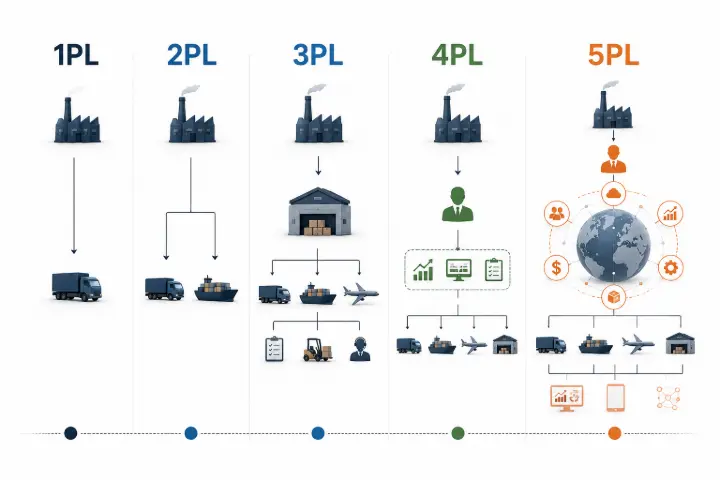
| Model | Who Manages Operations? | Level of Outsourcing | Best Suited For |
|---|---|---|---|
| 1PL | The company itself | None | Small businesses with local distribution |
| 2PL | The company + transport/storage provider | Limited | Businesses needing specific transport or storage only |
| 3PL | Specialized logistics provider | High | E-commerce and growing businesses |
| 4PL | Strategic supply chain manager | Very High | Multi-branch and global enterprises |
| 5PL | Fully integrated digital network manager | Highest | Global corporations with complex supply networks |
How to Choose the Right Logistics Model?
Selecting the appropriate model depends on several key factors:
- Business scale and volume
- Annual shipment capacity
- Geographical reach (local vs. international)
- Available budget
- Desired level of control
- Supply chain complexity
Small businesses often start with 1PL or 2PL, while medium-sized businesses transition to 3PL to leverage operational scale. Global enterprises managing complex operations typically adopt 4PL or 5PL models to achieve end-to-end integration and optimized performance.
Conclusion
The 1PL, 2PL, 3PL, 4PL, and 5PL frameworks serve as actionable models to help organizations structure their supply chains according to their business size, goals, and operational complexity. Moving to a higher tier does not imply that lower-tier models are inefficient; rather, each model fulfills a specific strategic purpose.
As international trade and supply chains grow increasingly complex, adopting integrated logistics solutions has become essential for boosting operational efficiency, reducing overhead, and sustaining a competitive edge in both local and global markets.