The movement of freight and transportation is one of the fundamental pillars of modern global trade. It serves as the bridge connecting countries and markets, enabling the continuous flow of goods and products across continents. As the global economy has expanded and demand for goods has increased, shipping methods have evolved significantly, becoming more diverse, efficient, and capable of meeting the needs of different markets.
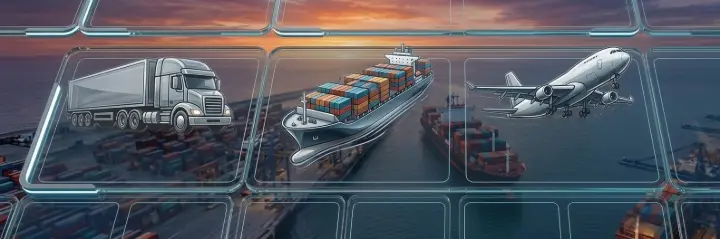
Shipping is no longer simply the process of moving goods from one location to another. It has become a sophisticated logistics system that relies on technology, supply chain management, strategic planning, and the integration of multiple transportation modes. As a result, three primary shipping methods have become the backbone of international trade: sea freight, air freight, and land freight.
Sea Freight
Sea freight is considered the backbone of international trade, transporting the majority of goods exchanged between countries, particularly across continents. This shipping method relies on large commercial vessels capable of carrying containers, bulk cargo, and raw materials in enormous quantities.
With technological advancements, modern cargo ships have become significantly larger and more efficient. Ports have also undergone major developments to accommodate the rapid growth of global trade. Today, sea freight remains the preferred choice for long-distance international transportation between major markets.
Air Freight
Air freight is the fastest mode of transportation available and is primarily used for goods that require rapid delivery or have high value. These include electronics, pharmaceuticals, sensitive products, and urgent shipments.
The sector has experienced remarkable growth alongside the expansion of e-commerce, making air freight an essential component of international order fulfillment. Advances in cargo aircraft and airport infrastructure have further enhanced its ability to serve global markets efficiently.
Land Freight
Land freight serves as the essential link within the transportation chain. Goods are transported via trucks and railways either within a country or between neighboring countries. It plays a crucial role in connecting seaports and airports with distribution centers and final markets.
As road infrastructure and logistics networks continue to improve, land freight has become more organized and efficient through the adoption of modern vehicle tracking technologies, fleet management systems, and route optimization tools.
Comparison of Shipping Methods
| العنصر | الشحن البحري | الشحن الجوي | الشحن البري |
|---|---|---|---|
| السرعة | منخفضة | عالية جدًا | متوسطة |
| التكلفة | منخفضة | مرتفعة جدًا | متوسطة |
| القدرة الاستيعابية | عالية جدًا | محدودة | متوسطة |
| الاستخدام | التجارة الدولية الضخمة | الشحن السريع والعالي القيمة | النقل المحلي والإقليمي |
| الاعتماد العالمي | الأعلى | متوسط | مرتفع محليًا |
| المرونة | أقل | عالية | عالية |
Evolution of the Shipping Industry
The shipping industry has undergone tremendous transformation over recent decades. Logistics operations now rely heavily on digital technologies and intelligent systems. Digitalization has improved shipment management, reduced operational errors, increased supply chain efficiency, and enabled real-time cargo tracking.
The Future of Transportation and Global Supply Chains
The Future of Sea Freight
Sea freight is responsible for transporting approximately 80–90% of global trade volume, making it one of the most influential sectors in the world economy. Today, however, it is entering a period of significant transformation.
1. Expansion of Maritime Routes and Modern Ports
Major shipping routes such as the Suez Canal and the Panama Canal continue to undergo expansion projects to accommodate larger vessels. At the same time, countries are investing heavily in smart ports that utilize automation to reduce loading and unloading times.
2. Rise of Ultra-Large Container Ships
Leading shipping companies, including Maersk, are deploying ultra-large container vessels capable of carrying tens of thousands of containers on a single voyage. These vessels reduce transportation costs per container and improve operational efficiency, although they require highly advanced port infrastructure.
3. Transition Toward Green Shipping
The maritime industry is actively working to reduce carbon emissions through:
- Low-carbon fuels such as methanol and ammonia
- Improved ship hull designs
- Artificial intelligence for fuel-efficient route optimization
According to the International Maritime Organization (IMO), the industry aims to achieve net-zero greenhouse gas emissions around the middle of the century.
4. Specialized Cargo Vessels
There is increasing demand for specialized vessels designed to transport liquefied natural gas, renewable energy components, and heavy industrial equipment, enhancing both safety and operational performance.
5. Digitalization and Smart Maritime Operations
Modern vessels increasingly rely on digital systems connected directly to ports, enabling:
- Real-time shipment tracking
- Lower fuel consumption
- Improved fleet management
Companies such as Wärtsilä are leading the development of intelligent operational solutions for maritime transportation.
The Future of Air Freight
Air freight remains the fastest and most time-sensitive mode of transportation, particularly for medical and technology industries.
1. Expansion of Air Cargo Infrastructure
Major airports continue expanding dedicated cargo facilities to support the rapid growth of global e-commerce.
2. Advanced Cargo Aircraft
Airlines are investing in dedicated cargo aircraft featuring larger capacities and smarter loading systems, improving transportation speed and efficiency.
3. Sustainability in Aviation
Key developments include:
- Sustainable Aviation Fuel (SAF)
- More fuel-efficient aircraft engines
- Data-driven optimization to reduce fuel consumption
According to the International Air Transport Association (IATA), the aviation industry aims to achieve carbon neutrality by 2050.
4. E-commerce Driving Growth
The explosive growth of online shopping has significantly increased demand for express air freight, particularly for international deliveries within 24–48 hours.
5. Specialized Air Cargo Services
The sector continues expanding services for:
- Temperature-controlled pharmaceutical transportation
- High-value electronics
- Time-sensitive cargo
The Future of Land Freight
Land transportation connects ports, airports, and final consumers while undergoing major technological transformation.
1. Smart Road Infrastructure
Governments are investing in intelligent transportation networks equipped with smart traffic management systems to reduce congestion and improve logistics efficiency.
2. Autonomous Trucks
Real-world testing of self-driving trucks has already begun. These vehicles are expected to reduce:
- Traffic accidents
- Operating costs
- Dependence on long-haul drivers
3. Electric and Hydrogen Vehicles
The road freight industry is gradually transitioning toward electric and hydrogen-powered vehicles to reduce emissions, particularly in urban logistics operations.
4. AI-Based Fleet Management
Companies increasingly use artificial intelligence to analyze operational data, optimize delivery routes, and reduce fuel consumption.
5. Integrated Logistics Networks
Land transportation has become an integral part of a unified logistics ecosystem connecting:
- Seaports
- Airports
- Distribution centers
Transportation as an Integrated Intelligent System
The future is not focused on developing each transportation sector independently but rather on fully integrating sea, air, and land transportation into one intelligent logistics ecosystem powered by:
- Artificial Intelligence (AI)
- Internet of Things (IoT)
- Big Data Analytics
- Automation
This transformation enables supply chains to become more resilient and adaptable to global disruptions such as pandemics and geopolitical events.
Conclusion
Shipping is no longer merely the movement of goods from one location to another. It has evolved into a comprehensive global system driven by technology, sustainability, operational efficiency, and digital innovation. As transportation technologies continue to advance, global logistics networks will become faster, smarter, and better connected, enabling businesses and markets around the world to operate with greater efficiency than ever before.